The Future Of Hope
“Success is as perilous as failure; hope is as hollow as fear. What does that mean? Whether you rise or fall, you stand on unstable ground.”
—Attributed to Laozi’s Dao De Jing
(The Classic Book Of The Way And Its Virtue, 206 BCE–220 CE)
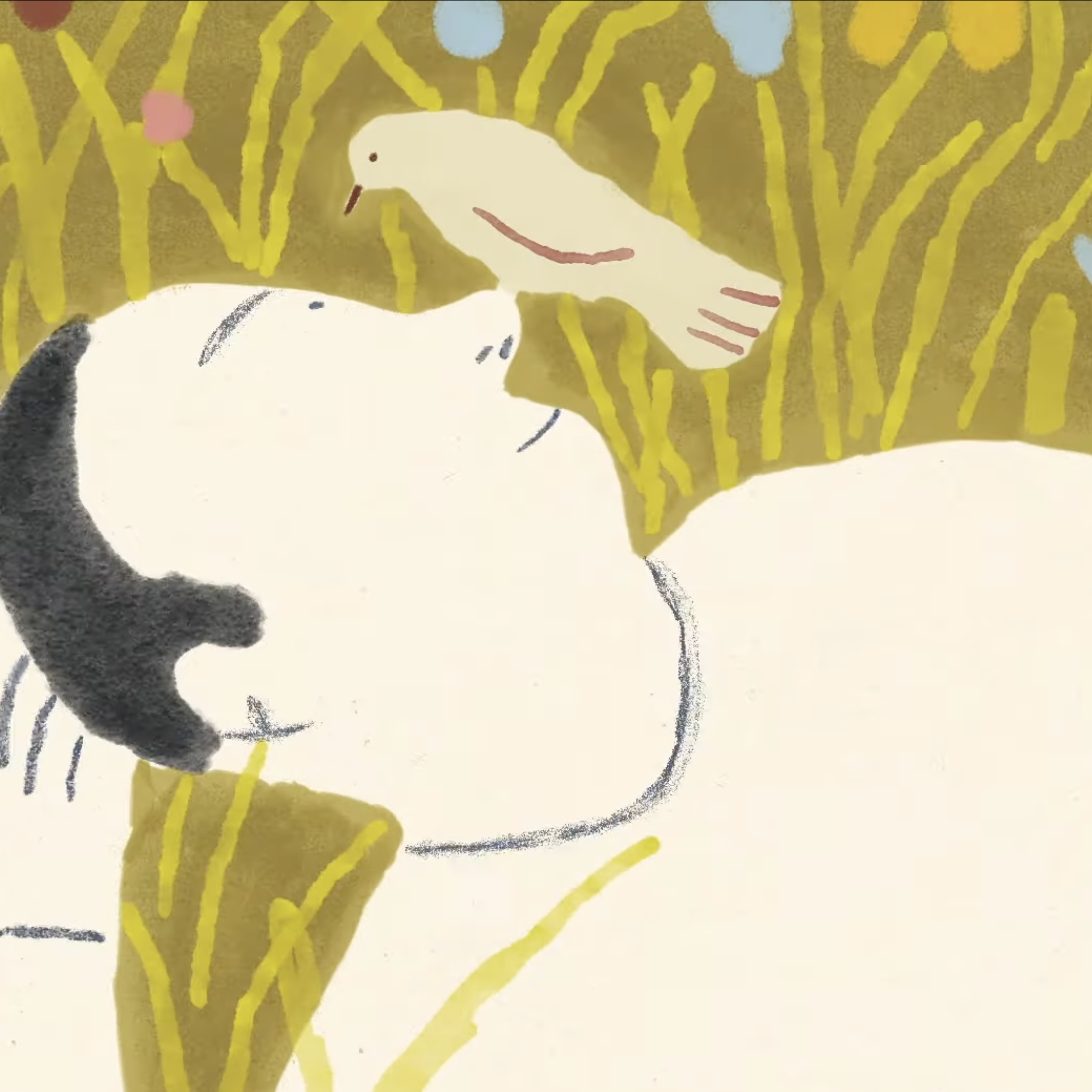
Image Screenshot “The Peace Of Wild Things” by Wendell Berry
A Poetry Film by Charlotte Ager & Katy Wang
“The Peace Of Wild Things” by Wendell Berry, A Poetry Film by Charlotte Ager & Katy Wang
The Peace Of Wild Things
By Wendell Berry
“When despair for the world grows in me, and I wake in the night at the least sound in fear of what my life and my children’s lives may be, I go and lie down where the wood drake rests in his beauty on the water, and the great heron feeds. I come into the peace of wild things who do not tax their lives with forethought of grief. I come into the presence of still water, and I feel above me the day-blind stars waiting with their light. For a time I rest in the grace of the world, and am free.”
—Wendell Berry
Turiya & Ramakrishna (1970) by Alice Coltrane
The Future Of Hope
From On Being with Krista Tippett
Intro by Krista Tippett
The Future Of Hope 5
Ai-jen Poo and Tarana Burke
The Future Of Hope 4
Michael Pollan and Katherine May
The Future Of Hope 3
Pico Iyer and Elizabeth Gilbert
The Future Of Hope 2
Darnell Moore and dream hampton
The Future Of Hope 1
Kate Bowler and Wajahat Ali
Sit Around The Fire | By Jon Hopkins, Ram Dass, East Forest | From the album Music For Psychedelic Therapy
“Beyond all polarities, I am. Let the judgments and opinions of the mind be judgments and opinions of the mind, and you exist behind that. It’s really time for you to see through the absurdity of your own predicament. You aren’t who you thought you were. You just aren’t that person. And in this very lifetime you can know it. Right now. The real work you have to do is in the privacy of your own heart. All of the external forms are lovely, but the real work is your inner connection. If you’re quiet when you meditate, if you truly open your heart… just quiet your mind, open your heart. Quiet the mind. Open the heart. How do you quiet the mind? You meditate. How do you open the heart? You start to love that which you can love and just keep expanding it. You love a tree, you love a river, you love a leaf, you love a flower, you love a cat, you love a human, but go deeper and deeper into that love ’til you love that which is the source of the light behind all of it. You don’t worship the gate, you go into the inner temple. Everything in you that you don’t need, you can let go of. You don’t need loneliness, for you couldn’t possibly be alone. You don’t need greed because you already have it all. You don’t need doubt because you already know. The confusion is saying, “I don’t know.” But the minute you are quiet you find out that in truth you do know. For in you, you know. Plane after plane will open to you. I want to know who I really am. As if in each of us there once was a fire, and for some of us there seem as if there are only ashes now. But when we dig in the ashes we find one ember, and very gently we fan that ember, blow on it, it gets brighter, and from that ember we rebuild the fire. Only thing that’s important is that ember. That’s what you and I are here to celebrate. That though we’ve lived our life totally involved in the world, we know, we know that we’re of the spirit. The ember gets stronger, flame starts to flicker a bit, and pretty soon you realise that all we’re going to do for eternity is sit around the fire.”
—Ram Dass
From the album Music For Psychedelic Therapy (2021) by Jon Hopkins
From On Being with Krista Tippett, Psychedelic Science and Radical Healing, a conversation with Gül Dölen
Words Make Worlds Make Music Make Universes
A collection of poetry films from The On Being Project
“Singularity”
by Marissa Davis, performed by Toshi Reagon
“The Peace Of Wild Things”
by Wendell Berry, A Poetry Film by Charlotte Ager & Katy Wang
“How To Be Alone”
by Pádraig Ó Tuama, A Poetry Film by Leo G Franchi
“Kindness”
by Naomi Shihab Nye, A Poetry Film by Ana Pérez López
“Let This Darkness Be A Bell Tower”
by Rainer Maria Rilke, A Poetry Film by Matt Huynh & Mila Nery
“Letter To My Body”
by Joy Ladin, A Poetry Film by Elyse Kelly
“The World”
by Rumi, A Poetry Film by Ella Dobson
“This Is What Was Bequeathed Us”
by Gregory Orr – Poetry Film by Taian Lu
“Ars Poetica #100: I Believe”
by Elizabeth Alexander, A Poetry Film by Jocie Juritz
The Natural World, Joy, And Human Becoming
“Psalm 150”
by Jericho Brown, A Poetry Film by Travis Wood
“My God It’s Full Of Stars”
by Tracy K. Smith, A Poetry Film by Daniel Bruson
“The More Loving One”
by W.H. Auden, A Poetry Film by Liang-Hsin Huang
POSTSCRIPTUM:
–REBECCA SOLNIT
–MARY OLIVER
–KEELEY GOULD
–LUCKY PEOPLE CENTER INTERNATIONAL
–AUSTRALIAN CHAMBER ORCHESTRA X WILLIAM BARTON
Rebecca Solnit: The Left’s Next Hero Is Already Here | The Interview
“How does the critically acclaimed progressive writer Rebecca Solnit view the world? In our era of democratic backsliding, technological disruption and looming climate disaster, is there a more hopeful way to enact change?
“Solnit has written a new book, “The Beginning Comes After The End,” a thematic sequel to her classic “Hope In The Dark.” David Marchese, a host of “The Interview,” says the new book “shines a light on the vibrant world often hidden within our own seemingly gloomier one — a world that has embraced ideas of interconnection, ecological care and political equality.”
“Solnit and Marchese discuss fighting climate change, countering Donald Trump, the power of the people in Minneapolis and more during their conversation.”—The Interview
“Readers looking for policy prescriptions or organising strategies, or even ideas for how to draft a simple, local, civic to-do list of their own may be disappointed. But as a deliberate exercise in reframing – as an open-ended invitation to consciously adopt new paradigms – The Beginning Comes After the End is very effective. Solnit is wise to focus on the nonlinear, and sometimes almost entirely invisible ways that change happens: “so subtly, so slowly, that only a milestone lets you know that it has been taking place all along, lets you see that many small changes add up to a large one”.
“An old world is dying, she’s certain; we’re in the midst of its violent last gasps. What comes next remains to be seen.”
A Thousand Mornings
Mary Oliver reads from her book of poetry on Oct 15, 2012 at the 92nd Street Y
“1. Why should I have been surprised? / Hunters walk the forest / without a sound. / The hunter, strapped to his rifle, / the fox on his feet of silk, / the serpent on his empire of muscles — / all move in a stillness, / hungry, careful, intent. / Just as the cancer / entered the forest of my body, / without a sound.
“2. / The question is, / what will it be like / after the last day? / Will I float / into the sky / or will I fray / within the earth or a river — / remembering nothing? / How desperate I would be / if I couldn’t remember / the sun rising, if I couldn’t / remember trees, rivers; if I couldn’t / even remember, beloved, / your beloved name.
“3. / I know, you never intended to be in this world. / But you’re in it all the same. // So why not get started immediately. // I mean, belonging to it. / There is so much to admire, to weep over. // And to write music or poems about. // Bless the feet that take you to and fro. / Bless the eyes and the listening ears. / Bless the tongue, the marvel of taste. / Bless touching. / You could live a hundred years, it’s happened. / Or not. / I am speaking from the fortunate platform / of many years, / none of which, I think, I ever wasted. / Do you need a prod? / Do you need a little darkness to get you going? / Let me be as urgent as a knife, then, / and remind you of Keats, / so single of purpose and thinking, for a while, / he had a lifetime.
“4. / Late yesterday afternoon, in the heat, / all the fragile blue flowers in bloom / in the shrubs in the yard next door had / tumbled from the shrubs and lay / wrinkled and faded on the grass. But / this morning the shrubs were full of / the blue flowers again. There wasn’t / a single one on the grass. How, I / wondered, did they roll or crawl back to / the shrubs and then back up to / the branches, that fiercely wanting, / as we all do, just a little more of / life?”
—Mary Oliver
Putting On A Pow Wow
By Keeley Gould | Nowness
“So we are the dancing apes. Man must dance.”
Lucky People Center International (1998)
Directed by Erik Pauser, Johan Söderberg
Spirit Voice Of The Enchanted Waters
Australian Chamber Orchestra
Spectrum | Max Cooper (Official video by Christian Stangl)
MORE WORDS AND MORE WORLDS AT
WHAT MATTERS | BEAUTY